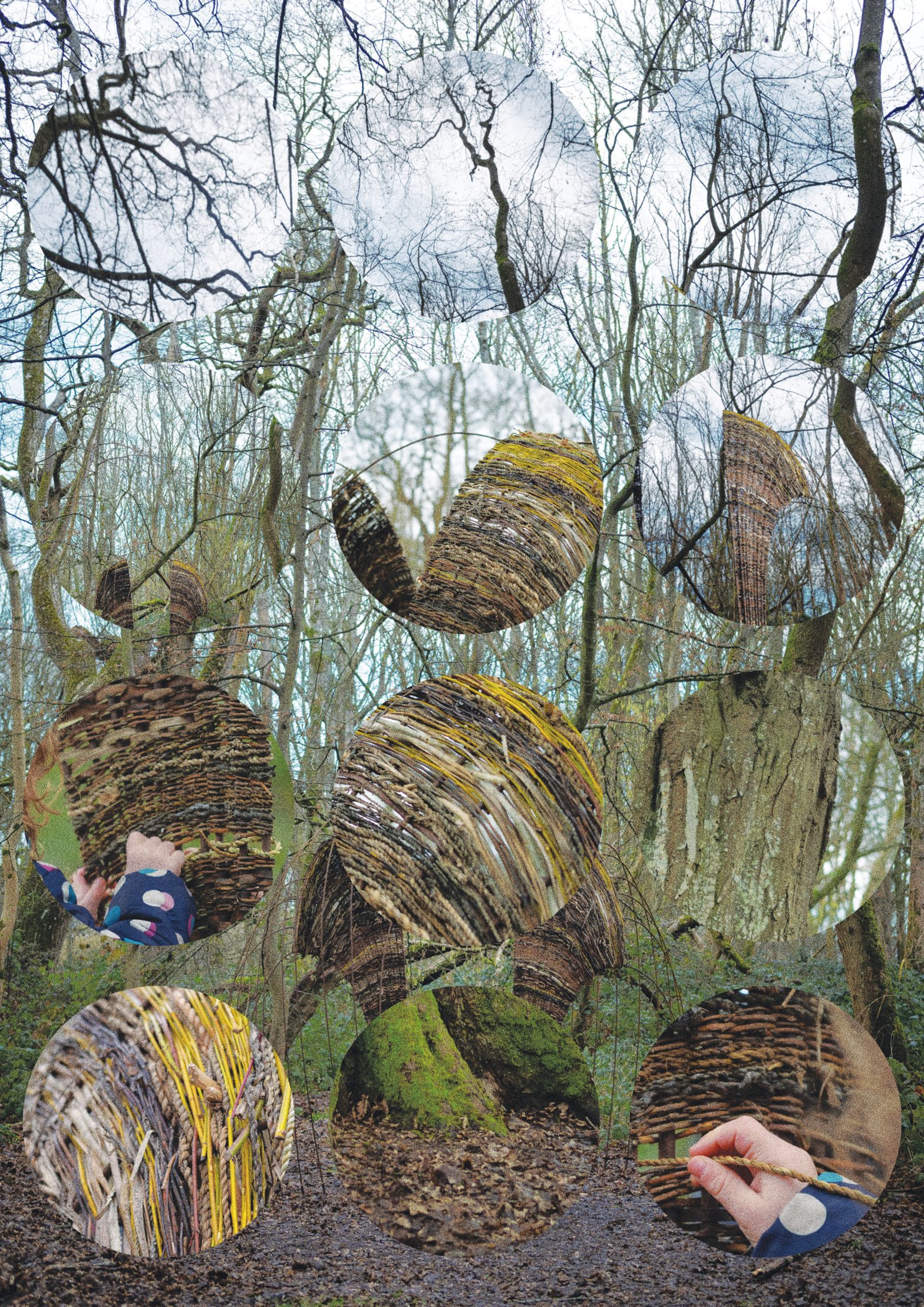
Ahead of Foraging Connections opening, artists Arbie Edward and Lilli Tranborg spoke with curator Holly Broughton about the themes and ideas in the exhibition.
HB: The title, Foraging Connections, suggests both the physical act of gathering materials and a social one of building relationships. Could you tell us more about this choice of exhibition title?
AE: It references the social, natural, and scientific. It’s the people, the environment, and the history as well. We wanted to look at the connectedness between each other as well as nature.
LT: Foraging is about the natural environment as a site of co-production. The project has been about the connectedness between us, as a group, with the natural world. And the family unit. We wanted to bring everyone into nature to have that respite. Breathe in the phytoncides – natural compounds emitted by trees that boost our immune system – have a moment of creativity, and experience the healing power of nature.
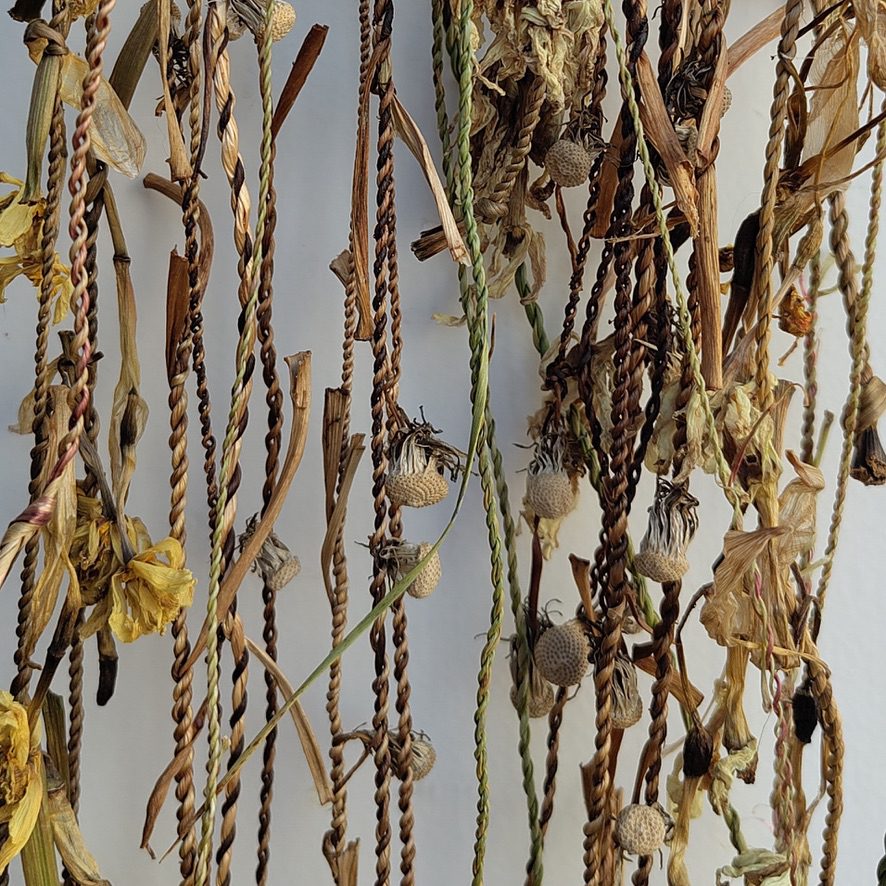
AE: It’s also about the strength found in togetherness. If you pick a single stem, it’s fragile and you can’t do anything with it. But if you dry it, rehydrate it, and twist it into cordage with other stems, you can get a rope strong enough to tie a horse.
LT: It’s amazing how the same material that is weak on its own becomes strong together. That is a key theme of this project. We wanted the sessions to offer a space of calm – to invite everyone to breathe in the air and experience that restorative power.
HB: Collaborative practice has been fundamental to this project. How have the partnerships, both between yourselves and with Children Heard and Seen, guided your approach to developing this work?
LT: We have known each other a long time – we met at Pilates and then a natural dye workshop here at the gallery – but we really clicked in 2018 during Modern Art Oxford’s How Nature Builds project, in collaboration with Wytham Woods. We both have science backgrounds and a love of nature. Our practices complement each other really well and we share an ethos of deep respect for the materials we use.
AE: We were the nosiest and loudest in the How Nature Builds project! In every session we were saying, ‘This is amazing, what more can we do?’
LT: With Children Heard and Seen, our sessions focused on bringing the families together with activities that could engage and inspire children and adults of all ages.
AE: It’s so lovely to see a two-year-old making phytograms or a thirteen-year-old creating cordage. They get into that ‘flow state’ where they are totally absorbed in the activity.
LT: The willow chains are an embodiment of that collaborative approach. By creating individual loops, we could link them together, so it becomes this communal artwork. You can’t say that bit was made by that person or that person. It’s all collectively made by the group.
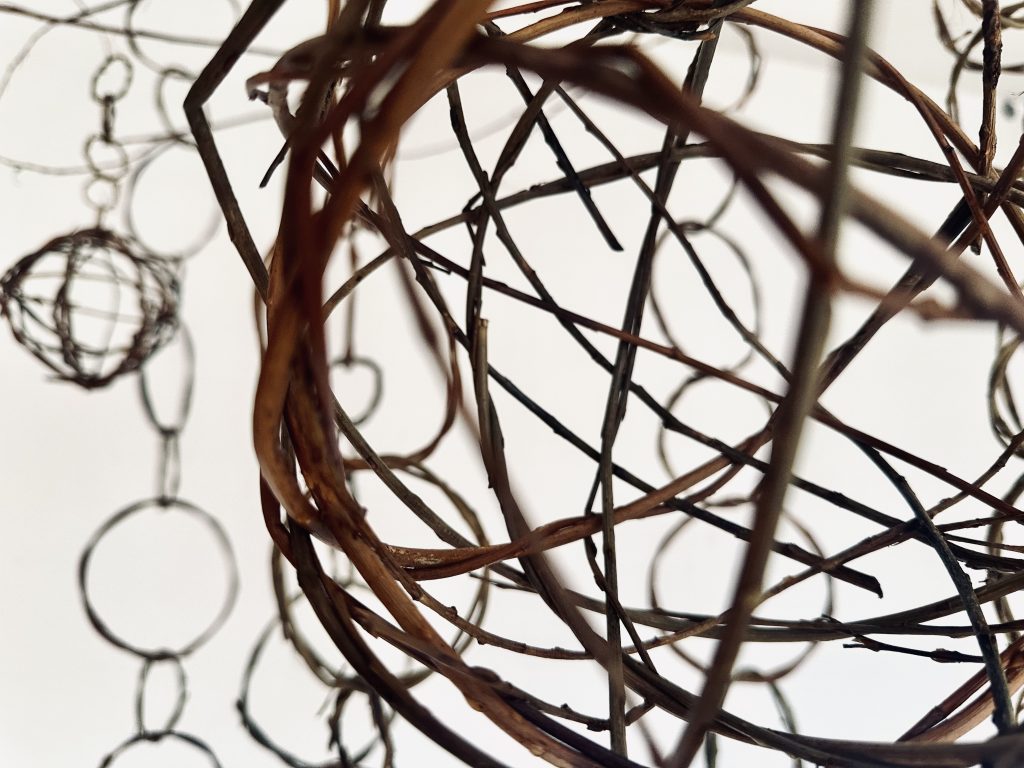
AE: Yes, it’s the power of that. Because one hoop on its own doesn’t have the same impact, but when you join them all together and suspend them, you’ve got a Celestial Forest. That joint effort creates something quite magical.
LT: It’s about human and nature connectedness. We often see the world solely from our own perspective, but we share it with a vast network of non-human life. Even trees communicate with each other. We are part of an ecology, but we often forget that when living in our urban boxes. This project is a step toward remembering those links.
HB: Could you tell us more about Continuing Bodies, and why you felt it was important to revisit and rework this artwork?
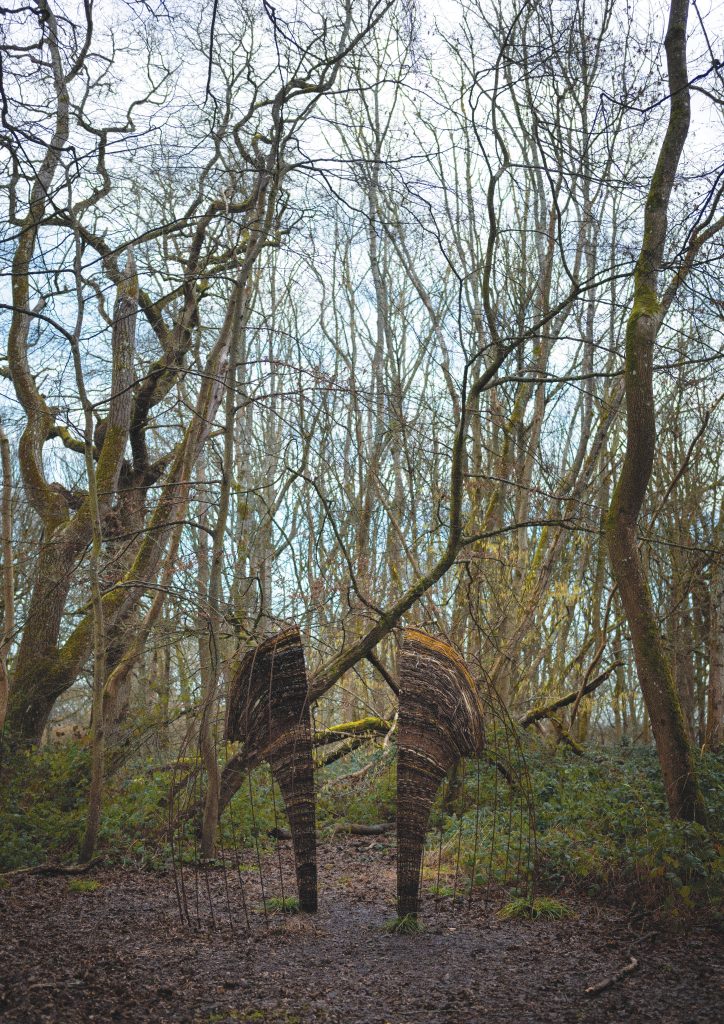
Note: Continuing Bodies (2018) was a large-scale, lung-shaped sculpture created by a group of local artists in Wytham Woods. It featured a steel frame with mycelium bricks (a sustainable material grown from fungal networks), designed to slowly decay back into the woodland floor.
LT: Wytham Woods is one of the most researched woodlands in the world. It’s a really ancient woodland; they have these ‘flux towers’ measuring how much carbon dioxide the woodland absorbs during the day and releases at night – it’s super exciting.
AE: We didn’t know how long it would last because of the mycelium bricks. As it started to decay, Lilli was up there monitoring it regularly, and I kept badgering her every couple of months, ‘Why don’t we mend this? We could repair it with cordage from things in the woods’*.
LT: I wanted to monitor the decay first – I called that project BreathDecay. I didn’t know it was going to take five years! So, when all the mycelium had finally gone, I contacted Arbie straight away and said, ‘It’s all gone. Now we can do it’.
AE: It’s in our practice to reuse, remake, restyle. The structure was empty and it was a bit sad really. By repurposing the original steel frame, we created a ‘second skin’. It bridges the history of the site with this new collaboration.
LT: Continuing Bodies was a really important project for my practice, where I decided that I wanted to take my art practice more seriously. It was such an opportunity to do a large-scale work out in nature – I’d never been able to before. How many artists get that opportunity? Most of us have small studio spaces where it’s hard to make something this big. I love working outdoors, using natural materials, and working collaboratively with a team. It’s funny how one little thing leads to another; this project actually led me to volunteer at the gallery and eventually pursue my Master’s in Fine Art.
AE: We even wonder now if this is a lifetime project for us – will we just carry on adding different materials and making new shapes?
HB: This exhibition brings the feel of the woodland into the gallery. Could you tell us more about the materials and techniques you work with?
AE: We used flowers, leaves, vegetables, grasses – anything with enough fibre for cordage (the ancient art of making rope by hand). If we need something, we’ll try and find it, forage for it, or borrow it from friends and family.
LT: On almost every walk we do, in the city or out in nature, we pick up beautiful plants, sticks, grasses, and leaves. When you notice the beauty of nature and its structures you realise you cannot surpass it, but we can endeavour to highlight the wonders of nature through sculptural processes, and bring that to the gallery.
AE: Cordage-making is one of the oldest technologies in the world; remains of cordage have been found dating back 50,000 years. We wanted the children to feel part of that history.
LT: We’ve explored the science of the woodland too. For instance, willow is amazing as a material; it contains salicin, the active ingredient in aspirin. Even animals feeding from it can get that benefit of pain relief. We wanted to encourage connectedness in the workshops, through the wonders of the natural world.
AE: It’s that deep respect for materials.
LT: When you work with natural materials, it impacts all the senses: you smell the green willow, you feel the tension of the branches, and you see the beauty of the different materials. We kept that wonder at the core of the project. In the first session, one of the children, who is only seven or eight, got so excited about the trees, and actually knew quite a lot already! I was like ‘wow this is amazing’. Nigel Fisher, the conservator, took us for a tour of the Woods and explained how you can tell the age of a tree by its rings. The group were fascinated by scientific details, such as tracking mice or calculating how many caterpillars a Blue Tit needs to feed its chicks (roughly 60–70 per chick per day). The children have talked about that visit, and the tree hugging one, ever since.
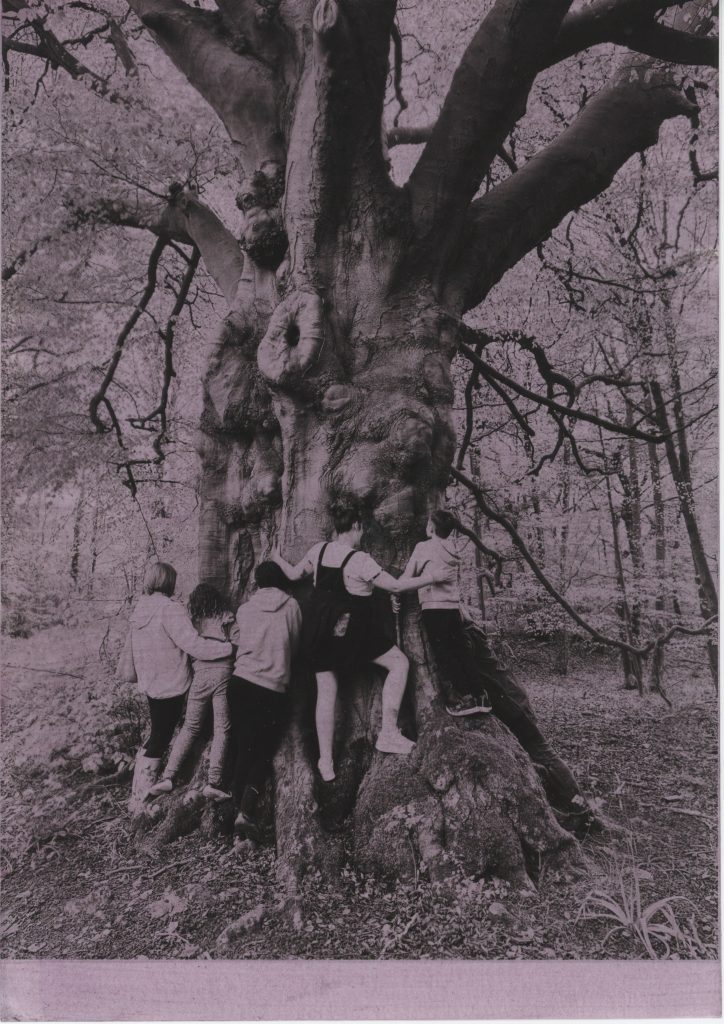
*As a site of scientific research we weren’t able to forage in the woods but Nigel Fisher, the Conservator of the woods, very kindly helped us source some hazel branches which we processed on site to include some bark in the sculpture. One of his colleagues also sourced some reed mace for us whilst she was monitoring the water in the ponds on site which we used in both the sculpture and exhibition.
To visit Wytham Woods you need a walking permit, to apply for one please go to https://www.wythamwoods.ox.ac.uk/permit and the location of the sculpture is at ///sides.button.ideal
You can visit Foraging Connections in our Ground Floor gallery from 27 March – 14 June 2026. Free, no booking required.